Published paper
Abstract
This paper considers the question of how one can translate evidence of nonlinearities and threshold effects in growth into policy recommendations. We argue that the current evidence of these effects, while important in terms of scholarly debates, does not readily lend itself to policy evaluation. The reasons for this are two-fold. First, the existing evidence on nonlinearities is relatively difficult to integrate into a common coherent view. Different models of nonlinearity appear in different papers; these models are often nonnested and do not present a clear alternative to linear growth models. Second, we argue that the econometric evidence of nonlinearities is often developed in ways that do not allow one to examine explicitly the effects of alternative policies on growth. We describe some recent econometric methods that can address these problems. To illustrate the utility of these methods we then study the current debate on the efficacy of aid on growth in developing countries. We find that none of our methods suggests that aid should be given to countries with better policy quality. In fact, when considering robust policies, our results strongly reject the conclusion that aid should be allocated in higher amounts to countries where the policy quality is high.
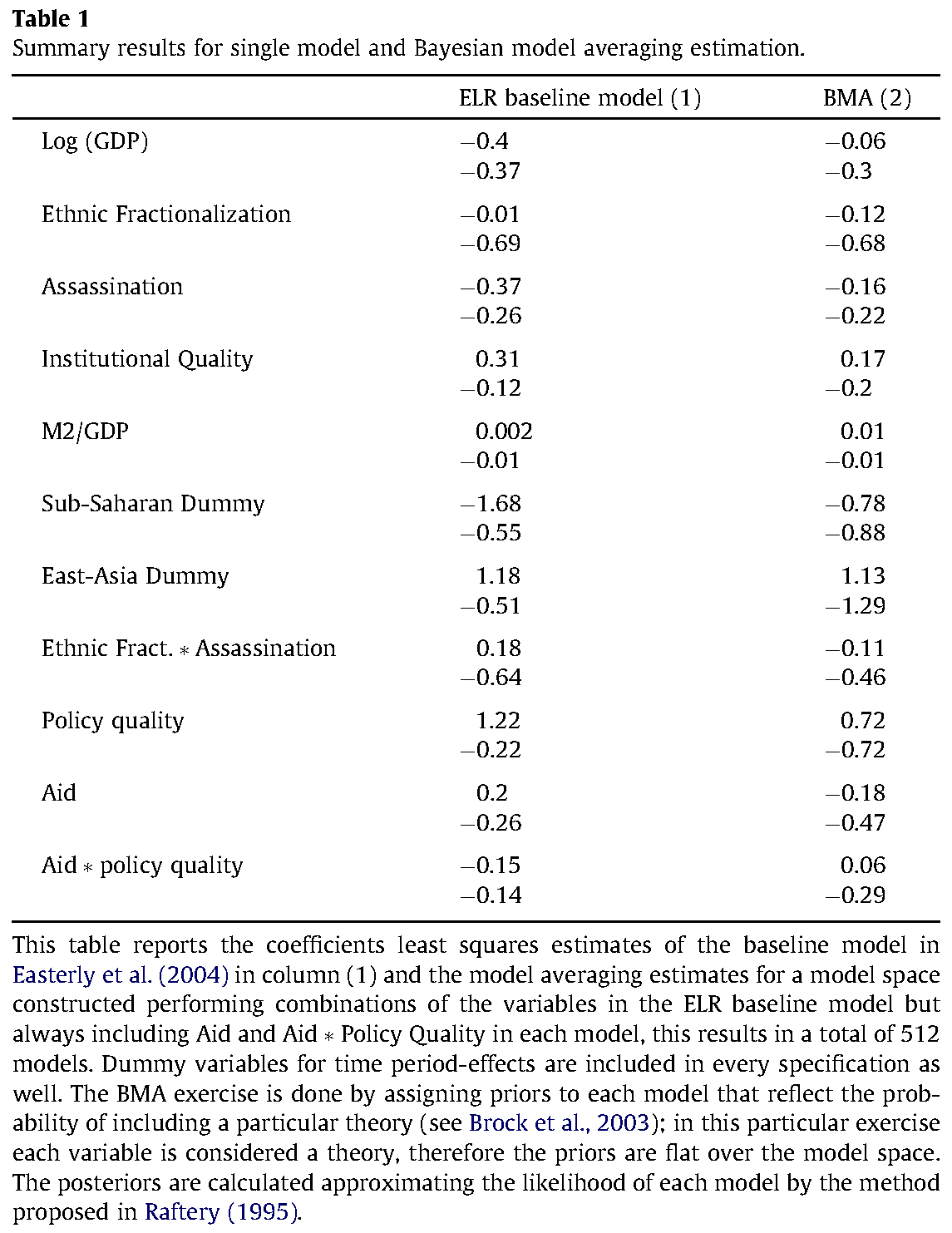
Table 1: Summary results for single model and Bayesian model averaging estimation
Citation
Ethan B. Cohen-Cole, Steven N. Durlauf, and Giacomo Rondina. 2012. “Nonlinearities in Growth: From Evidence to Policy.” Journal of Macroeconomics 34 (1): 42–58. https://doi.org/10.1016/j.jmacro.2011.07.001 .