Published paper
Abstract
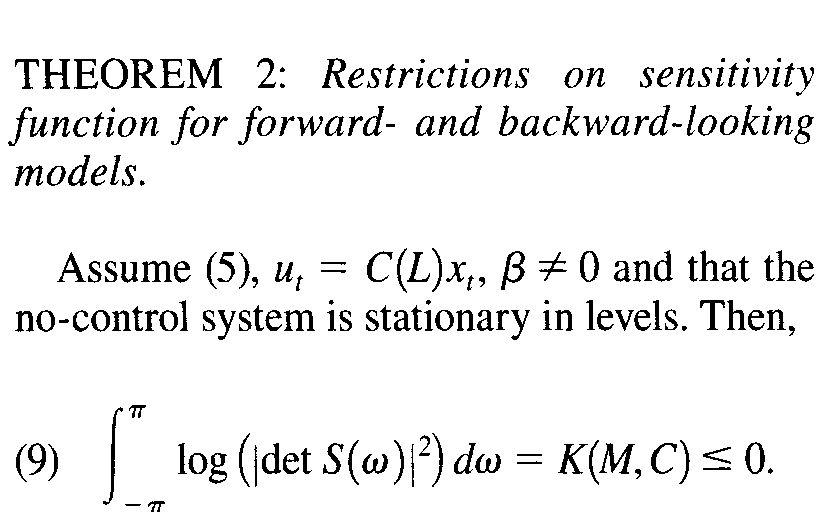
We examine the tradeoffs that stabilization policies create between fluctuations at different frequencies. These design limits constrain whether a feedback rule can reduce volatility at every frequency or must increase volatility at some frequencies to reduce it at others. In backward-looking models, such tradeoffs are unavoidable. Introducing forward-looking behavior changes the constraints and can permit reductions in volatility at all frequencies, while leaving tradeoffs over the degree of stabilization. These results show why policy evaluation should consider frequency-specific effects alongside overall variance, particularly when policymakers are uncertain about the economic model or the appropriate loss function.
Theorem 2
Citation
William A. Brock, Steven N. Durlauf, and Giacomo Rondina. 2008. “Frequency-Specific Effects of Stabilization Policies.” American Economic Review: Papers & Proceedings 98 (2): 241–245. https://doi.org/10.1257/aer.98.2.241 .